How AI Voice Agents Are Changing the Way Businesses Handle Customer Communication

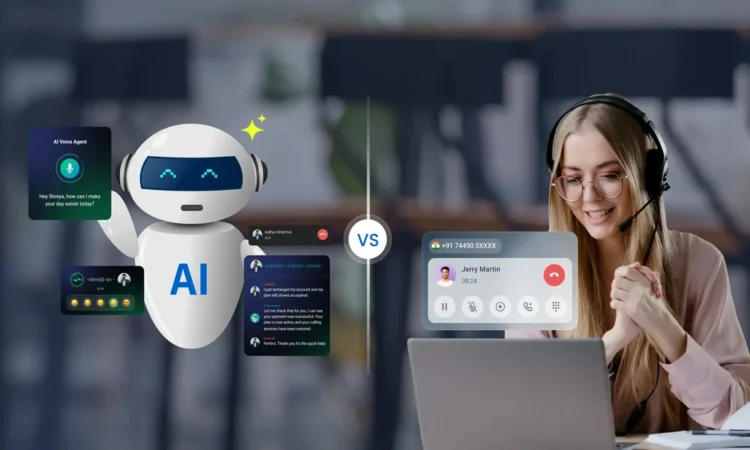
Voice has always been one of the most natural forms of human communication, and businesses have long relied on phone-based customer service as a primary touchpoint. The emergence of AI voice service for business has introduced a fundamentally different approach to managing voice interactions at scale. Rather than routing calls through large teams of human agents, companies are now deploying AI voice agents that can handle inquiries, gather information, and complete defined workflows autonomously. Understanding how this technology works and where it applies is increasingly important for businesses across the United States.
What Is an AI Voice Service for Business?
An AI voice service for business is a system that uses speech recognition, natural language understanding, and text-to-speech synthesis to interact with customers or internal users through spoken conversation. Unlike traditional interactive voice response (IVR) systems, which rely on rigid menu trees, modern AI voice agents understand natural language inputs and can conduct fluid, context-aware conversations.
These systems can be deployed across inbound customer service lines, outbound sales or survey calls, appointment booking, payment reminders, and internal helpdesk functions. The key distinction from earlier voice automation is the ability to handle variation in how people speak, adapt to unexpected inputs, and escalate to a human agent when the conversation exceeds the system’s defined capabilities.
Core Components of AI Voice Agent Development Services
Building a reliable AI voice agent involves several interconnected components working in tandem. The core elements that make up a fully functional system are:
- Automatic speech recognition (ASR) to convert spoken input into text for processing
- Natural language understanding (NLU) to identify intent and extract key entities from speech
- Dialogue management to maintain context across multi-turn conversations
- Text-to-speech (TTS) synthesis to generate natural-sounding spoken responses
- Integration layer to connect the voice agent with CRM, ticketing, and backend systems
AI voice agent development services cover the design and implementation of each of these components, along with the conversation design work that determines how the agent should respond in different scenarios. Well-designed conversation flows account for the range of ways customers might phrase a request, as well as graceful handling of input that falls outside expected patterns.
Business Applications of AI Voice Agents in the US Market
Healthcare organizations are using AI voice agents to handle appointment scheduling, prescription refill inquiries, and post-visit follow-up calls. Financial services firms deploy voice agents for account balance inquiries, fraud alerts, and routine transaction queries. Retail and e-commerce companies use them for order status updates and return initiation, freeing human agents to handle more complex interactions.
The consistent benefit across these applications is scale. A single AI voice agent can handle thousands of simultaneous conversations without the variability in quality that comes from large human teams. For businesses managing high call volumes with a significant proportion of routine inquiries, this efficiency translates directly into cost reduction and faster resolution times.
When AI Voice and Human Agents Work Together
The most effective voice AI deployments are not designed to eliminate human agents but to optimize the distribution of work between automated and human-handled interactions. Routine, high-volume inquiries that follow predictable patterns are handled by the AI voice agent, while complex, sensitive, or high-value interactions are escalated to human agents who can apply judgment and empathy that the system cannot replicate.
Seamless escalation is a critical design requirement. When a caller needs to be transferred to a human agent, the AI system should pass along a complete summary of the conversation to avoid the customer repeating information. This handoff quality often determines whether customers perceive the overall experience as helpful or frustrating, regardless of how well the AI agent performed on its own.
Evaluating AI Voice Service Providers
For US businesses evaluating AI voice agent development services, the key selection criteria include the quality of natural language understanding across accents and speaking styles, the ability to integrate with existing telephony infrastructure, compliance with data privacy regulations such as HIPAA or CCPA where applicable, and the provider’s track record in the specific industry vertical.
Deployment timelines, ongoing support commitments, and pricing models (per-minute, per-call, or subscription-based) vary significantly across providers and should be evaluated in the context of the organization’s expected call volumes and use case complexity. Proof-of-concept engagements that test the voice agent against a sample of real call recordings are a practical way to assess performance before committing to a full deployment.
The Role of Conversation Design in Voice AI Success
Technology alone does not determine the quality of an AI voice agent deployment. The conversation design, which defines how the agent responds to different inputs, handles ambiguity, and manages exceptions, is equally important. Poorly designed conversation flows create frustrating experiences even when the underlying speech recognition and natural language understanding are technically accurate.
Effective conversation design requires deep understanding of how the target customer population actually speaks. Regional accents, common phrasings, and the types of requests that arrive most frequently should all inform the conversation design process. Organizations that include voice recordings from actual customer calls in the design and testing process consistently report better outcomes than those who design conversations entirely from assumption. Understanding concepts like ai ml services helps in making better decisions in this field.
Measuring the Performance of AI Voice Systems
Deploying an AI voice agent without a measurement framework leaves organizations unable to determine whether the system is delivering value or creating new problems. Key performance indicators for AI voice agents include containment rate (the percentage of calls resolved without human escalation), first contact resolution rate, customer satisfaction scores, and average handle time compared to the human-agent baseline.
Regular call recording review and transcript analysis are essential for identifying gaps in the AI agent’s conversation design. Cases where the agent failed to understand the customer’s intent, gave incorrect information, or escalated unnecessarily point to specific conversation flows that need refinement. This continuous improvement cycle is what separates mature AI voice deployments from ones that degrade in performance over time.